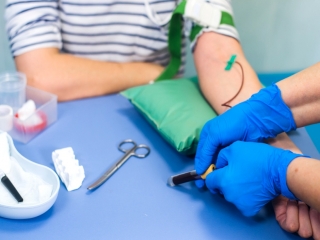
Phlebotomy Theory and Refresher Course

Categories: phlebotomy training
Wishlist Share

About Course

This comprehensive course provides the theoretical knowledge and supervised practical training required to safely perform venepuncture in accordance with UK clinical standards.

The theory component covers anatomy, infection control, equipment selection, consent, documentation, complications, and professional accountability.

The practical session includes hands-on supervised training, correct technique demonstration, and competency assessment.

This course does not replace workplace competency sign-off. Final authorisation to practise independently remains the responsibility of the employer.

Certificate issued upon successful completion of theory assessment and practical attendance

What Will You Learn?

  • • Understand the principles of safe venepuncture
  • • Identify suitable veins for blood collection
  • • Apply infection prevention and ANTT principles
  • • Select correct equipment and blood bottles
  • • Understand consent, documentation and professional accountability
  • • Recognise complications and how to respond safely

Course Content

Theory Module
This theory module provides the essential knowledge required to safely perform venepuncture in accordance with UK clinical standards. Learners will gain an understanding of infection control, ANTT principles, vein anatomy, equipment selection, consent, documentation, complications, and professional accountability. Course Overview This course provides the theoretical knowledge required to safely perform venepuncture in accordance with UK clinical standards. This course alone does not permit independent clinical practice. Practical supervision and competency assessment are required before performing venepuncture unsupervised. Learning Outcomes By the end of this session, learners will be able to: • Define phlebotomy and its clinical purpose • Understand professional accountability and scope of practice • Apply infection prevention and control principles • Explain ANTT (Aseptic Non Touch Technique) • Identify correct venepuncture equipment • Select appropriate blood collection tubes • Demonstrate knowledge of safe needle technique • Identify suitable veins for venepuncture • Recognise complications and appropriate responses • Understand post-procedure care and documentation requirements Introduction to Phlebotomy Phlebotomy is the clinical procedure of collecting blood samples for laboratory testing. Accuracy, patient identification, infection control, and patient safety are essential at every stage of the procedure. Professional Accountability Practitioners are accountable to patients, employers, and the public. Safe practice and working within scope are mandatory. Phlebotomists must: • Work within their level of training and competence • Maintain confidentiality • Obtain informed consent • Accurately document procedures • Escalate concerns appropriately • Follow local policies and national guidance Infection Prevention & Control Standard precautions apply to all patients. Key principles include: • Effective hand hygiene • Appropriate use of PPE • Safe sharps handling and disposal • Cleaning of equipment and clinical areas • Prevention of cross-contamination ANTT (Aseptic Non Touch Technique) ANTT prevents contamination by protecting key parts and key sites during procedures. Key principles: • Do not touch key parts • Use sterile equipment where required • Maintain a clean field • Minimise exposure time Venepuncture Equipment Correct equipment preparation reduces errors, delays, and contamination. Equipment may include: • Blood collection system (vacutainer or syringe) • Blood collection tubes • 21G green needle (standard adult size) • Tourniquet • Alcohol wipes • Gauze and dressing • Sharps container • Sample labels and request forms • PPE Blood Collection Tubes Tube selection affects test accuracy. Additives must match requested investigations. Common examples: • EDTA (purple top) – Full Blood Count • SST (gold/yellow top) – Biochemistry Incorrect tube selection may invalidate results. The correct order of draw must be followed to prevent additive cross-contamination. Needles & Technique 21G green needles are commonly used for adults. The needle bevel must face upwards. Recommended insertion angle: 15–30 degrees. Only trained and assessed practitioners should perform venepuncture. Anatomy & Veins Veins carry deoxygenated blood from the tissues back to the heart (excluding pulmonary veins). Superficial veins in the antecubital fossa are commonly used for venepuncture. Vein Selection The median cubital vein is preferred due to stability and lower complication risk. Avoid: • Areas of infection • Oedema • Bruising • AV fistula sites • Mastectomy side (unless clinically cleared) Possible Complications Complications may include: • Haematoma • Syncope (fainting) • Nerve irritation • Infection • Failed attempt Practitioners must recognise complications early and escalate appropriately. Sharps Safety Sharps must be disposed of immediately into an approved sharps container. In the event of a sharps injury: 1. Encourage bleeding 2. Wash area with soap and water 3. Report immediately 4. Follow local incident reporting procedures Post-Venepuncture Care Proper pressure, observation, and documentation protect patient safety. The practitioner must: • Apply firm pressure • Ensure bleeding has stopped • Provide aftercare advice • Label samples immediately • Complete documentation accurately

  • Phlebotomy Theory Manual
  • Course Overview
  • LEARNING OUTCOMES
  • MODULE 1 – INTRODUCTION TO PHLEBOTOMY
  • Purpose of Phlebotomy
  • Role of the Phlebotomis
  • Patient Safety
  • Professional Behaviour
  • Importance of Training and Competence

MODULE 2 – PROFESSIONAL ACCOUNTABILITY

MODULE 3 – INFECTION PREVENTION & CONTROL

MODULE 4 – ANTT (ASEPTIC NON TOUCH TECHNIQUE)

MODULE 5 – VENIPUNCTURE EQUIPMENT

MODULE 6 – BLOOD COLLECTION TUBES

MODULE 7 – NEEDLES & TECHNIQUE

MODULE 8 – ANATOMY & VEINS

MODULE 9 – VEIN SELECTION

MODULE 10 – POST- VENEPUNCTURE CARE

PHLEBOTOMY TRAINING FINAL ASSESSMENT (QUESTIONS 1–30)

Student Ratings & Reviews

No Review Yet
No Review Yet
Scroll to Top